

Why Your Therapy Practice Isn't Showing Up on Google

If you've ever typed your own practice name into Google and felt a small stab of panic at the results, you're in good company. Most therapists in private practice have spent real money and real time on their website — only to find it sitting quietly on page two, doing nothing.
The frustrating part is that the fixes are rarely complicated. What most therapy websites lack isn't better copy or nicer photos. It's the foundational structure that helps Google understand who you are, where you are, and who you help.
This guide walks through the essentials — specifically for therapists using Squarespace, and specifically for the way clients in the UK search for support.
Why local search is everything for private practice

When someone decides they need a therapist, they're rarely browsing nationally. They search for someone nearby. "Therapist near me." "Anxiety counsellor in Bristol." "CBT therapist Edinburgh." These are local searches — and Google responds to them differently from general searches.
Rather than a list of websites, Google often shows a map with three local results first — what's sometimes called the local pack. Getting into that map view is one of the most valuable things a private practice can do for its online visibility.
The implication is important: you don't need to compete with national platforms or large directories to get clients from Google. You need to be the most relevant local result. That's a much more achievable goal.
Start with your Google Business Profile

Your Google Business Profile (previously called Google My Business) is the free listing that appears when someone searches for your practice or for therapists in your area. If you haven't claimed yours, that's the first thing to do. It costs nothing and has an outsized effect on local search visibility.
A few things to get right from the start:
Choose your category carefully. Options include "Psychotherapist," "Counsellor," and "Mental Health Service," among others. Pick the category that most accurately describes your practice — your primary category carries the most weight in how Google ranks you locally.
Keep your details consistent. Your practice name, address, and phone number on your Google Business Profile should match exactly what's on your website — and on any directories you're listed in, like Counselling Directory or Psychology Today. Inconsistencies signal unreliability to Google.
List your services. You can add individual services directly to your profile — things like "individual therapy," "CBT," "couples counselling," or "trauma therapy." Use the terms your clients would recognise, not just clinical language.
Stay active. Profiles that show regular activity — a photo updated occasionally, a post now and then — tend to perform better in local results than dormant ones. Even one post a month makes a difference.
On reviews. Google reviews are a meaningful local ranking signal, and there's nothing wrong with letting a client know you'd appreciate one. That said, if you're registered with BACP, UKCP, or another professional body, it's worth reading their current guidance on testimonials. The ethical considerations around therapeutic relationships are specific enough that it's worth being informed before you start asking.
What your Squarespace website actually needs
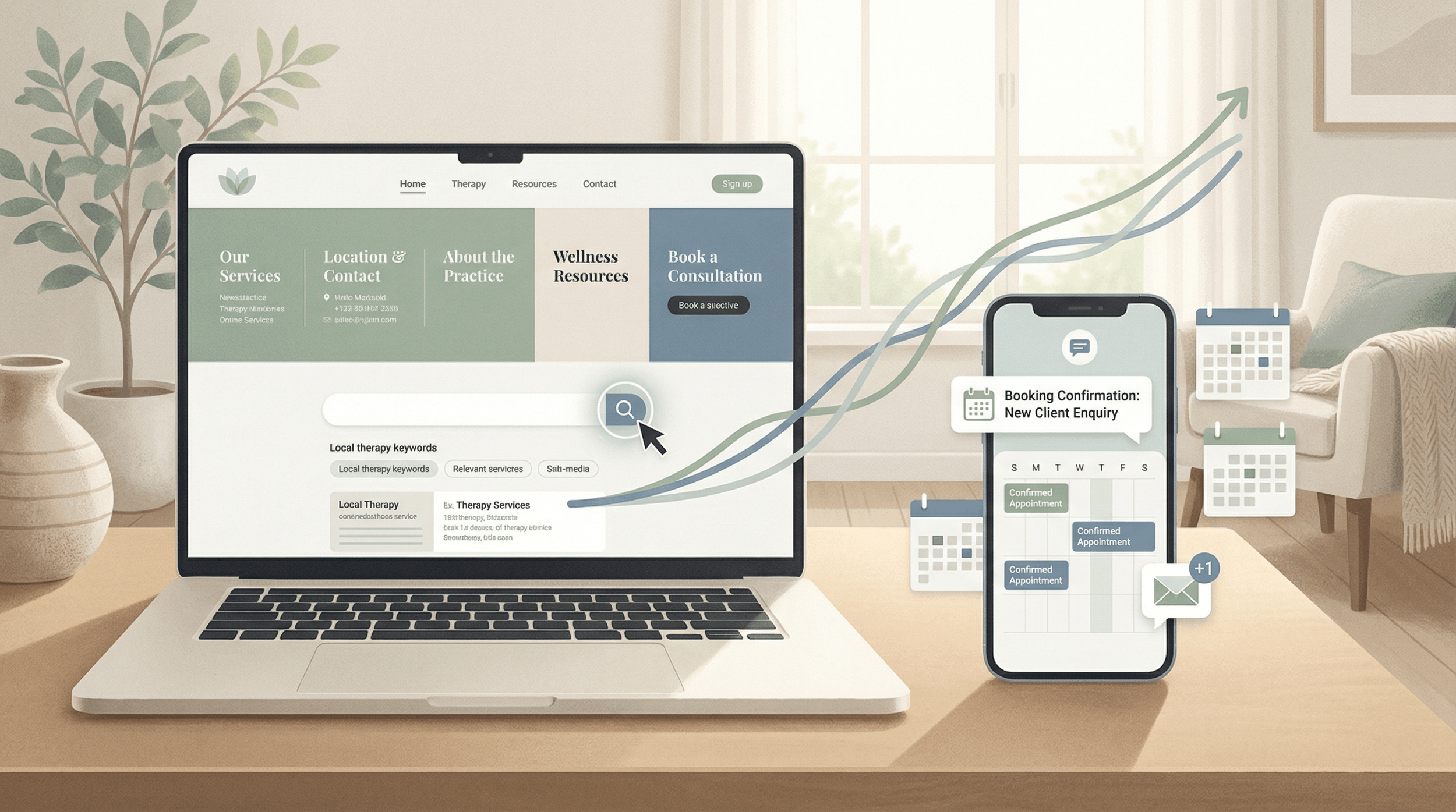
A visually polished website and an SEO-optimised website are not the same thing. Here's what most therapy sites on Squarespace are missing.
Tell Google where you are — plainly. Your homepage needs to communicate, clearly, who you are, where you practice, and what you help with. "I offer CBT and integrative counselling for adults in Manchester" is more useful to a search engine — and to a nervous potential client scanning your site — than something intentionally poetic but vague. You can still write warmly; just be specific.
Give each service its own page. A single "Services" page listing everything you offer gives Google very little to work with. Individual pages — one for anxiety therapy, one for couples counselling, one for EMDR — each with a focused description and your location mentioned naturally, give Google a clear signal for each search someone might make. They also make it easier for potential clients to find exactly what they're looking for.
Write your own SEO titles and meta descriptions. In Squarespace, every page has a dedicated SEO title and meta description field — and they're too often left blank or auto-generated. Your SEO title should include your main keyword and your location (e.g., Anxiety Therapy in Edinburgh | Sarah Williams Counselling). Your meta description is the short text that appears under your link in search results — write it as an invitation, not a generic summary.
Use Squarespace's SEO tools. Since the 2025 platform update, Squarespace includes an AIO (AI Optimisation) panel, found under Settings → Marketing → SEO Appearance. This includes an SEO Completion Score and an SEO Scanner that surfaces missing metadata across your pages. Spend an hour working through any issues it flags — it's one of the faster wins available to you.
Check mobile performance. Squarespace templates are mobile-responsive by default, but it's still worth opening your site on your phone and checking how it actually loads and reads. Google uses mobile experience as a ranking factor, and most local searches happen on phones.
Keywords: practical, not overwhelming
You don't need specialist tools or a marketing background to pick useful keywords. Think like someone who's decided they want help, and ask yourself what they'd type.
Common patterns for therapists:
"[Specialism] therapist in [city]" — e.g., CBT therapist in Leeds
"Counsellor in [area]" — e.g., counsellor in Cheltenham
"Therapist for [issue] [location]" — e.g., therapist for anxiety London
"[Specialism] near me" — Google uses location data to resolve "near me" searches
Use these phrases naturally in your page headings, the first paragraph of your key pages, your meta titles, and your image alt text. Once or twice per page, in context, is enough. Forcing them to appear repeatedly will work against you.
One quick shortcut: start typing a relevant phrase into Google and look at the suggestions that appear. Those are based on real searches from real people — that's useful data, and it's free.
A word on patience
SEO is not fast. Making solid changes today typically produces visible improvement in local search results over three to six months, though some Google Business Profile changes can move faster than that. The work compounds — a well-structured website that ranks in your local area keeps generating enquiries without ongoing ad spend.
That's not a reason to delay. The best time to get the foundations right is now.
Want someone to handle this?
If working through SEO settings in the evenings isn't how you want to spend your limited time outside the therapy room, that's entirely fair.
At SQSP Agency, we work specifically with therapists, counsellors, and psychologists in private practice — building Squarespace websites that are structured for search from the start, and running Google Ads campaigns that reach the right people in the right area.
